While doing some research on African art and artifacts for an exhibition I'm involved in at Arts Worcester titled 'Call and Response' I came across this beautiful chair. Below is a description of the chair and the people who decorated it. I found it very interesting. I hope you do as well.
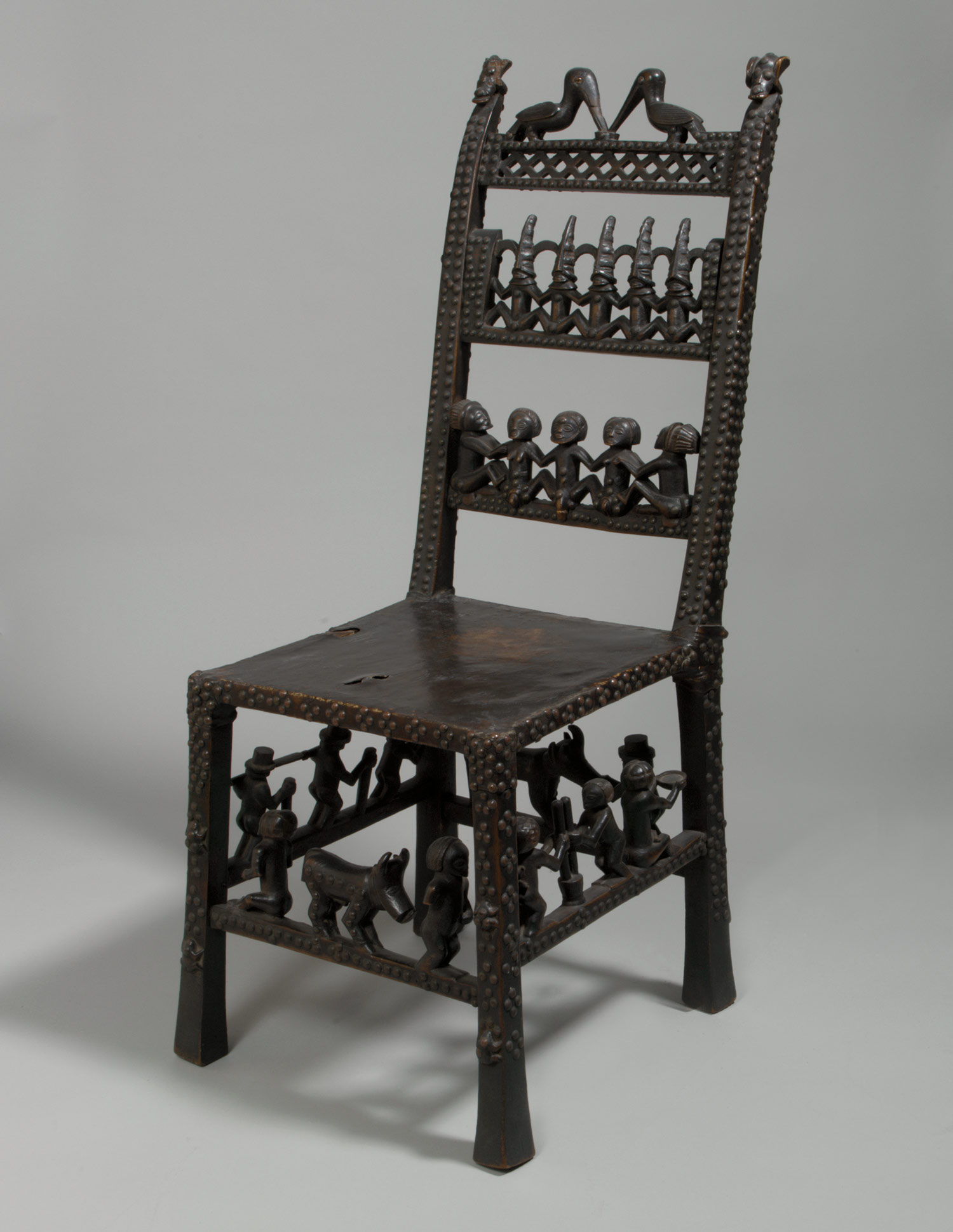

Chair, 19th–20th century
Chokwe peoples; Angola
Wood, brass, tacks, leather
Chokwe peoples; Angola
Wood, brass, tacks, leather
H. 39 in. (99.1 cm)
The Michael C. Rockefeller Memorial Collection, Purchase, Nelson A. Rockefeller Gift, 1970 (1978.412.619)
The Michael C. Rockefeller Memorial Collection, Purchase, Nelson A. Rockefeller Gift, 1970 (1978.412.619)
In many societies of Central Africa, such as the Chokwe and
related peoples like the Songo and the Ovimbundu, functional artifacts are
transformed into prestige objects that commemorate the power and status of the
chief. Chokwe chiefs possess many elaborately carved articles, including
ceremonial weapons, staffs of office, tobacco pipes, and seats of office like
this example in the Museum's collection.
Over the course of numerous encounters with European
traders as early as the seventeenth century, Chokwe chiefs appropriated the
design of certain types of Western artifacts. The seats of office, or "thrones,"
of Chokwe chiefs, with backs, leather-covered seats, and decorative brass tacks,
are modeled upon European chairs. The decoration of the chair, however, remains
distinctly Chokwe in style. The elaborate figurative scenes depicted on this and
other seats of office are designed as symbolic microcosms of life and represent
the breadth of a leader's concerns and responsibilities. The back uprights
contain scenes from the spiritual aspect of life, including depictions of
ancestors or chiefs. The dance figures along the bottom and the masked figures
along the second rung refer to Chokwe initiation rites. The conical masks, known
as cikunza, promote fertility and are used during the
circumcision rituals of Chokwe adolescents. The topmost rung features two ngungu birds. The ngungu bird is the
largest bird known to the Chokwe and is associated with hunting—a vocation with
which Chokwe leaders closely identify. It is also a good omen, a sign of success
in the hunt and therefore a sign of power. In addition, the ngungu serves as a mediator between the spiritual and earthly
realms, and is often displayed with other symbols of chiefly power.
The rows of figures along the stretchers at the base of the
chair are carved representations of scenes from everyday life. Images of hunting
or trading are common, as illustrated on the front and back rungs, which feature
men tending to cattle. In this piece, domestic activities like food preparation
are depicted on the side rungs. The proper left rung features women tending to
their children and pounding grain, while the proper right rung depicts men at
work. These quotidian scenes are universally identifiable to the king's
constituency and serve as a juxtaposition to the ritual events depicted at the
summit of the chair. The overall organization of these scenes creates a united
visual narrative emphasizing the social harmony and continuity that is
ultimately achieved through following the enlightened leadership of the chair's
owner, namely, the chief.
The Chokwe kingdom rose to power during the late nineteenth
century in the broad expanse of open savanna in the southern region of the
Democratic Republic of Congo and northern Angola. As the Chokwe population
expanded, they eventually conquered the previously dominant Lunda empire, which
declined after the abolition of the slave trade in the 1830s. The Chokwe peoples
thrived primarily because of the profitable trade of ivory, wax, and rubber with
the Portuguese. Chokwe chairs are among the few African objects not carved from
a single piece of wood, but are instead assembled in parts.
Although this artwork appears on the 20th-century segment of
the Timeline, it is ascribed a date of 19th–20th century.


No comments:
Post a Comment