Sunday, December 9, 2012

Call and Response Opening Reception

This past Friday evening Liesl and I attended the opening reception of the 'Call and Response' exhibition at Arts Worcester.  The opening was well attended.  Liesl and I have a piece in the exhibition.
The curator of the Fitchburg Art Museum in Fitchburg, MA was in attendance.  He is choosing a few pieces from this exhibition to travel to the Fitchburg Art Museum where they will be put on display alongside their African collection.


Friday, December 7, 2012

Call and Response Statement

The most well known and highly sought after mask of the Songye tribe is the Kifwebe mask.  These masks are typically associated with shapes as well as beautiful textured lines and linear scarifications.  The lines are usually painted with alternating black and white stripes, which give an almost hallucinating effect.  Kifwebe masks can be male or female, with crested comb structures identifying male masks, the higher the crest the more powerful the mask as well as the greater spiritual power of the dancer.
Male and female masks are danced together, with each dancer encouraging the desired qualities of the sexes.

For this exhibition I created a pair of tea lights based on the artistic qualities of the Songye Kifwebe mask.  I based the height of the candle towers on the elongated mouth of the mask.  The candle towers are made out of Baltic birch plywood.  I cut strips of plywood and then turned them on their side to expose the many layers and dark lines of the veneers.  I laminated the strips together to create solid panels that I then used to make the towers.  The lines of the plywood represent the lines of the mask. The candle bases are made from reclaimed pieces of African padouk wood.  The two walnut wedges piercing the top of the candle towers represent the male and female masks dancing together.


Sunday, December 2, 2012

Call and Response Candles

I really like how these candles worked out.  The black and white lines of the laminated plywood stripes are bold and striking.  I cut and glued up four pieces to make the candle towers.  I then cut a rabbet around the  bottom to accommodate the base.  I use some reclaimed African padauk wood for the bases.  I used an 1 1/2" forstener bit to drill a partial hole for to house the tea light.  I cut a couple of notches into the top to hold two walnut wedges.
I'm really happy with how these turned out.  I feel they respond to my chosen piece ( the mask) very well, while representing me and my aesthetic.


Plywood Candle Blanks

Once the plywood strips are laminated I rip and crosscut them to size so they'll fit into the jigs I use to create the patterns.  The patterns are made by cutting dadoes and grooves into the boards.  I have three jigs that I use.  The boards fit into the jig and the jig is ran over the dado blades at different measures.  I then use the second jig, turn the board over and pass it over the dado blades at different measures, creating a perforated look.  I then use the third jig to help me cut a miter on both sides.  


Plywood strips

I'm working on my Call and Response piece for Arts Worcester.  I'm using Baltic birch plywood for the lamp tower.  The mask I'm using as my inspiration piece is highly textured with lines and striations.  To mimic the mask I ripped strips of plywood on the table saw and then turned them on their side to expose the veneers (layers) of plywood.  I then laminated the strips together to form panels.


Wednesday, November 28, 2012

Songye Kifwebe Mask


Liesl and I are participating in an exhibition titled 'Call and Response" at the Aurora gallery of Arts Worcester.  
  'Call and Response' is a collaboration between the Fitchburg Art Museum and the members of ArtsWorcester.  Since late September, ten works of African art from the Fitchburg Art Museum has been on display at ArtsWorcester.  While only a glimpse of the vast diversity of African art, the loan includes the artwork of several African peoples—Songye, Kru, and Ife, among others—and different social functions, including masks, weapons, textiles, and portraiture. 

ArtsWorcester members are taking inspiration from these pieces in several ways: some respond to the artistic qualities of the pieces, their composition, or media.  Others are creating works inspired by their cultural uses (for example, as gifts, or currency).
Below is a Songye mask, similar to the one that I am using as inspiration to create my piece from.  I love the lines and striations in the texture of the mask.
For more infromation about the exhibition visit www.artsworcester.org


A  tribal people located in the Democratic Republic of Congo, the Songye are best known for their distinctive statuaries and masks, which for centuries have been used to protect villages, ward off enemies, and bring fertility and wealth. The Songye often named their statues and decorated them with horns, skins, beads, tacks, shells, and bits of cloth. As a result, each item displays a singular, impressive identity. Considered to be imbued with magical energy and used only by village shamans, these statues have enormous cultural and historical significance, and they are also powerful works of art in their own right.

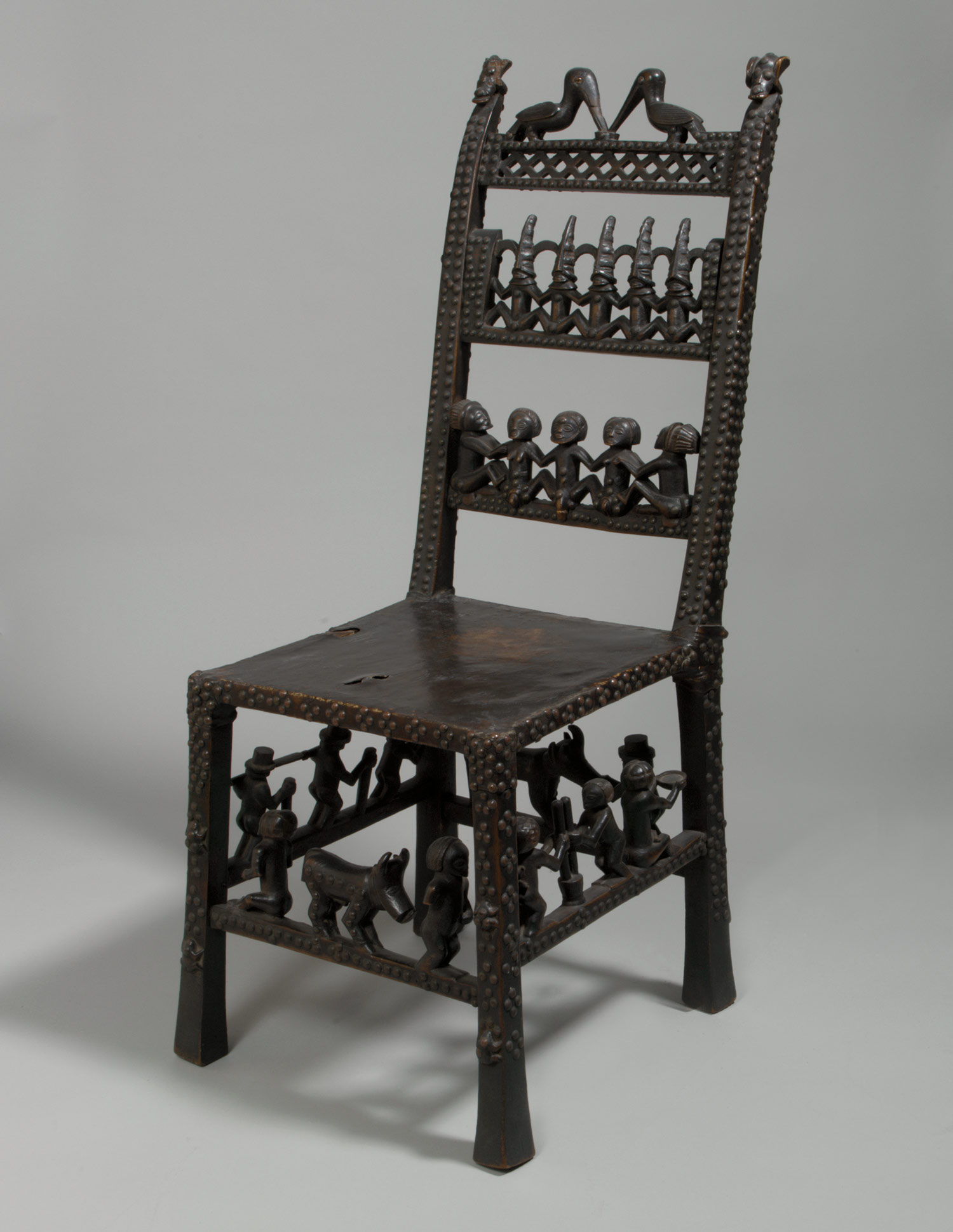
African Chair

While doing some research on African art and artifacts for an exhibition I'm involved in at Arts Worcester titled 'Call and Response'  I came across this beautiful chair.  Below is a description of the chair and the people who decorated it.  I found it very interesting.  I hope you do as well.  


  • Chair, 19th–20th century
    Chokwe peoples; Angola
    Wood, brass, tacks, leather

    H. 39 in. (99.1 cm)
    The Michael C. Rockefeller Memorial Collection, Purchase, Nelson A. Rockefeller Gift, 1970 (1978.412.619)


    In many societies of Central Africa, such as the Chokwe and related peoples like the Songo and the Ovimbundu, functional artifacts are transformed into prestige objects that commemorate the power and status of the chief. Chokwe chiefs possess many elaborately carved articles, including ceremonial weapons, staffs of office, tobacco pipes, and seats of office like this example in the Museum's collection.
    Over the course of numerous encounters with European traders as early as the seventeenth century, Chokwe chiefs appropriated the design of certain types of Western artifacts. The seats of office, or "thrones," of Chokwe chiefs, with backs, leather-covered seats, and decorative brass tacks, are modeled upon European chairs. The decoration of the chair, however, remains distinctly Chokwe in style. The elaborate figurative scenes depicted on this and other seats of office are designed as symbolic microcosms of life and represent the breadth of a leader's concerns and responsibilities. The back uprights contain scenes from the spiritual aspect of life, including depictions of ancestors or chiefs. The dance figures along the bottom and the masked figures along the second rung refer to Chokwe initiation rites. The conical masks, known as cikunza, promote fertility and are used during the circumcision rituals of Chokwe adolescents. The topmost rung features two ngungu birds. The ngungu bird is the largest bird known to the Chokwe and is associated with hunting—a vocation with which Chokwe leaders closely identify. It is also a good omen, a sign of success in the hunt and therefore a sign of power. In addition, the ngungu serves as a mediator between the spiritual and earthly realms, and is often displayed with other symbols of chiefly power.
    The rows of figures along the stretchers at the base of the chair are carved representations of scenes from everyday life. Images of hunting or trading are common, as illustrated on the front and back rungs, which feature men tending to cattle. In this piece, domestic activities like food preparation are depicted on the side rungs. The proper left rung features women tending to their children and pounding grain, while the proper right rung depicts men at work. These quotidian scenes are universally identifiable to the king's constituency and serve as a juxtaposition to the ritual events depicted at the summit of the chair. The overall organization of these scenes creates a united visual narrative emphasizing the social harmony and continuity that is ultimately achieved through following the enlightened leadership of the chair's owner, namely, the chief.
    The Chokwe kingdom rose to power during the late nineteenth century in the broad expanse of open savanna in the southern region of the Democratic Republic of Congo and northern Angola. As the Chokwe population expanded, they eventually conquered the previously dominant Lunda empire, which declined after the abolition of the slave trade in the 1830s. The Chokwe peoples thrived primarily because of the profitable trade of ivory, wax, and rubber with the Portuguese. Chokwe chairs are among the few African objects not carved from a single piece of wood, but are instead assembled in parts.

    Although this artwork appears on the 20th-century segment of the Timeline, it is ascribed a date of 19th–20th century.

    Thursday, November 22, 2012

    Making Call and Response


    Liesl and I are participating in an open members exhibition at Arts Worcester titled 'Call and Response'.
    On loan to Arts Worcester is a collection of African artifacts from the Fitchburg Art Museum in Fitchburg, MA.  I am creating a candle lamp using a mask in the collection as inspiration. The lamp is based on my modern tea lights I make.  I'm using plywood for the lamp tower and African padauk for the base.
    My response piece is the second artifact in the video,a mask,  which can be viewed above or at the Arts Worcester website www.artsworcester.org and click on the 'call and response' link.

    Wednesday, November 21, 2012

    'Gottasay'


    Liesl and I were recently interviewed by our writer friend Melissa Macdonald.  Her article is below as well as on her new blog 'Gottasay' which can be found on my blog links.

    Uxbridge crafters share life, gallery space and love of community


    When ArtsWorcester put out a call last spring for proposals for its next season of exhibits, Uxbridge, Massachusetts, furniture maker Steve Butler and his wife, jewelry maker Liesl Carlson, both got to work on individual proposals. After all, their respective crafts are about as dissimilar as they could be.
    A five-member panel, comprised of local artists, art history professors, appraisers and museum curators, reviewed the artists' submissions on their merits alone with no information about the artists. Butler's proposal made the cut out of more than 30 applicants.

    Then, in the process of mapping out his show, ArtsWorcester'sAurora Gallery, where his work was to be featured, had a dilemma. Accustomed to having the walls hung with art, the gallery staff wondered what to do to fill them, as Butler's work was not, for the most part, wall-friendly. One of the gallery staffers said, “How about Liesl's jewelry?” And a husband-and-wife show was born. “Co-Habitat: The Studio Work of Steve Butler and Liesl Carlson” is at ArtsWorcester's Aurora Gallery through November 30.

    Craft as art
    Juliet Feibel, executive director for ArtsWorcester, says, “Steve Butler's half of 'Co-Habitat' is ArtsWorcester's first exhibit of studio furniture. We're thrilled to have it, and equally excited to show Liesl Carlson's jewelry alongside it. This exhibit allows viewers to see how craft can and should be viewed as art, and how the divisions between the two are often meaningless.  

    “That Carlson and Butler are also married gives us an unusual glimpse into the shared world of two artists,” adds Feibel.

    Cynthia Woehrle, manager of the Aurora Gallery, says, “This show is fun and funky, and it's touchable, which not all fine art is.”

    The differences in the couple's work extend beyond their materials, Woehrle notes. “They are very yin and yang. Liesl says she couldn't draw or cut a straight line if her life depended on it, and Steve's work is, of necessity, so precise.”

    Because this was the Aurora Gallery's first 3D show, Butler built all the pedestals on which his work is displayed, and also made the cabinets where Carlson's jewelry is hung.

    Carlson says, “I'm really happy with how the show came out. It's really nice to see all my work on the walls. I've never seen it like that, and it looks fabulous.

    “It's also great to see so much of Steve's work in one place,” she adds. “I can fit all my work in a box, but it takes a storage unit for Steve's,” she laughs.

    Asked whether they subscribe to a particular school of art, Steve says, “I let other people define us. All I know is I have to make stuff.”

    Meet cute
    Butler and Carlson met while Carlson was a student in the professional crafts studies program at the Worcester Center for Crafts, where Butler taught. Butler was running the wood department, and as one of the program faculty, had to review Carlson's work.

    “The wood department was down this corridor you had to go through to get to other places in the building,” Carlson recalls, smiling. “I made a lot of trips down that corridor.”

    Says Butler, “She was very flirty.”

    Today, the couple has been married six-and-a-half years and has a four-year-old son, Quinn. Butler's workspace is in their home's garage, while Carlson has a studio in the shed out back, outfitted in large part by Butler, and with a space set aside for Quinn to create alongside his mom.

    The Aurora Gallery show marks the first time the duo have shown their work together, but not the last. “We will be showing together again at the Uxbridge Library in March,” Carlson reports.

    Says Butler, “We might have found ourselves a husband-and-wife niche! But she still has her own path and identity. We still have our separate things. We don't compete.”

    In fact, having a partner that understands the creative process makes for some synergy. “We constantly use each other as a sounding board,” Carlson says. “I'm always asking, 'What do you think of this piece? Are the proportions right?' Steve's sense of proportion is phenomenal; mine, not so much.”

    Butler adds, “Sometimes you need to step back from what you're working on; you're too close to it. You need someone else to take a look and tell you what they see. And that's what Liesl brings to me.”

    He notes that the fact that both are artisans also lends their household a flexibility not every family has.
    “We both totally understand that creating is not 9-5, so if one of us has to follow that middle-of-the night inspiration, we get it. We're also very good at alternating our studio times. Plus, it lets us be very free to be there for Quinn.”

    The art of economy
    Of course, having a two-artist family, with all the accompanying vagaries of the economy and market for art, isn't always a picnic. “It's not like when one partner has a steady, high-income job and the other is free to create,” says Butler. Both teach to boost income, and Carlson also recently began working as a part-time realtor. Beyond that, the pair do everything in their power to live frugally, aided by Carlson's bargain-hunting: Butler points to a sparkling stainless steel coffee percolator which Carlson found “for a dollar!”

    The drive to make ends meet while remaining free to work as artists has had a direct effect on the work both Butler and Carlson produce. “Much of Steve's work employs repurposed and upcycled wood and objects, and Liesl's silver is recycled as well,” notes ArtsWorcester's Feibel.

    Butler observes, “Repurposing is a trend now, but it's something we've always been into. It's like in the Depression Era. We've never had any money, so we have to make things work. It's a kind of pioneer spirit. It requires problem solving.

    “There's a greater sense of satisfaction than just making the object...that you did it under certain circumstances and you pulled it off. Sort of, 'Not only did we make art, but we did it without any money,'” says Butler.

    Working within limited means, says Carlson, “is always giving a new direction to our work, so we're constantly evolving.”

    Angling to bring artists together
    Butler, who hails from Canada originally, and Carlson, who is from Mendon, came back to this area a couple of years ago after spending several years living and working in the Peters Valley Craft Center, a community of artisans, part of the Delaware Water Gap recreational area. Both Butler and Carlson speak glowingly of their time there, and it's where Quinn was born.

    Driven by their first-hand experience of the benefits of living and working among a community of artists, Butler and Carlson hope to someday bring something akin to that to the Blackstone Valley.

    Bernat Mills, which had been a local spot for artists and musicians to work and gather, burned down in 2007, Carlson recollects. Since then, she says, there's been no venue for artists to work as a community.

    The pair have put a fair amount of personal effort into lobbying local officials for a craft center that would offer classes and bring people together. For now, the effort is on hold, but it's still a long-term goal.

    Another effort close to Butler's heart is pulling together a juried show of furniture created by regional artisans. In fact, that was one of the proposals he submitted to the gallery call for ArtsWorcester, though the individual show proposal that became “Co-Habitat” ultimately won out.

    “New England's got a long tradition of fine furniture crafting. With the furniture design programs at Rhode Island School of Design, University of Massachusetts at Dartmouth, and Maine College of Art and the Holy Cross sculpture department, there's a lot going on. So I'm looking for space to curate an exhibition.”

    In the meantime, Carlson is preparing to teach her “Bangles, Rings and Things” class (note: that link will take you to a review of the class, which yours truly took at Carlson's studio last summer) as well as a class on hollow form silver jewelry at the Worcester Center for Crafts in January. Butler, who hosts a public-access cable show about creating called “The Garage with Steve Butler,” is preparing to form a production company and, if all goes well, take the show to the next level: PBS.

    Thursday, November 8, 2012

    A Chorus Line

    There's a lot of leg to view at Arts Worcester this month.  The exhibition 'Co-Habitat" is on view until the end of November.  Thanks to Cynthia at Arts Worcester for taking this great picture, and for the opening line of this post.
    Photo: Lots of leg on view at ArtsWorcester: Co-Habitat, Friday, November 2, 6-8pm

    Tuesday, November 6, 2012

    "Co-Habitat' opening

    This past Friday was the opening reception of Liesls and mine exhibition 'Co-Habitat'.  We had a blast.  Thanks to everyone who came out for it and thanks especially to Liesl who's work is amazing. It feels great to see my work in one place. If you haven't seen the exhibition yet please visit the Aurora gallery at Arts Worcester and check it out. The exhibition runs through the month of November.


    Friday, November 2, 2012

    Installation Continues

    yesterday Liesl and I put the finishing touches on our exhibition installation.
    My apologies for the poor images.  Tonight is the opening reception.  I'm really proud of how the show looks.  It's nice to see all of our work we've done over the past while in one place.  It looks great'


    Thursday, November 1, 2012

    Installation

    Yesterday Liesl and I installed our exhibition at Arts Worcester.  We couldn't have done it without the help of Jeff Ellis and Kevin Bird.  Jeff helped load and unload our work and Kevin helped with the placement of our work.  Thank you'
    Below is my work space filled with painted pedestals. 


    Monday, October 29, 2012

    Pedestals


    I've been making pedestals for my pieces for the exhbition.  The pedestals are made out of 1/2 inch birch ply and will be painted an eggshell white.

    Friday, October 26, 2012

    'Co-Habitat'. Almost'

    The display cabinets for Liesls jewelry are finished.  I gave them two coats of eggshell color paint.  The plexi glass sleeves will slide into the grooves, much like a drawer bottom and lock into position. I'll be working on making pedestals to display my work.  The exhibit gets installed on Monday so I'll be busy all weekend making them.


    Tuesday, October 23, 2012

    Great day for painting

    Today was a great day to work outside.  I started painting the display cabinets I made for Liesls work in the exhibition 'Co-Habitiat'. I should finish them up tomorrow.


    Works in Wood


    This is an exhibition I'm in. My mahogany, aluminum, and stainless steel tea lights were accepted by the jurors.  The exhibition is at the New Hope Arts Cenrer in New Hope, PA.  It runs from November 10 to Decemberer 9.  If you know of someone who lives near or if you're going to be in that neck of the woods please visit the exhibition and look for my work. 


    Monday, October 22, 2012

    Pedestals and Disply Cabinets

    This week is all about getting ready for the exhibition.  This past weekend I made display cabinets for Liesls jewelry.  The cabinets are made out of pine, notched together and have a groove and dado running through them, much like a drawer bottom to house a piece of 1/8 inch plexi glass.  The top of the cabinet is exposed so the plexi panels can easily be removed.
    There are six panels in total


    Friday, October 19, 2012

    Getting Ready

    Liesl and I have been getting ready to install our exhibition next week.  I gathered up my product from different galleries and gift shops and started to give them a fresh coat of wax or oil.  Below are a couple of images of some tea lights and a tea box.  It's nice to see the tea box again, I really enjoy it.  It's made out of mahogany and has hand cut dovetails.  The box sits on a nest made out of mahogany and rosewood.


    Sunday, October 14, 2012

    Pallet Bench Completed

    I finished making the bench out of a large pallet.  I hung a 2" x 4" below and added a shelf.  The bench takes up a lot of room in my small space but it helps keeps things organized.